15 Easy Knitting Terms and Definitions for Beginners
15 Easy Knitting Terms and Definitions for Beginners If you&
15 Easy Knitting Terms and Definitions for Beginners If you&
If you’ve ever picked up a knitting pattern and felt completely lost, you are not alone. K2tog? YO? SSK? It honestly looks like a different language the first time you see it.
But here’s the good news: once you learn the most common knitting terms for beginners, reading patterns gets so much easier.

This guide covers all the essential knitting terms and definitions you’ll run into as a new knitter, from basic abbreviations to the fun community lingo that shows up on knitting blogs and social media. Bookmark this page and come back whenever you need a quick reference. We’ll be here!
Let’s get into it.
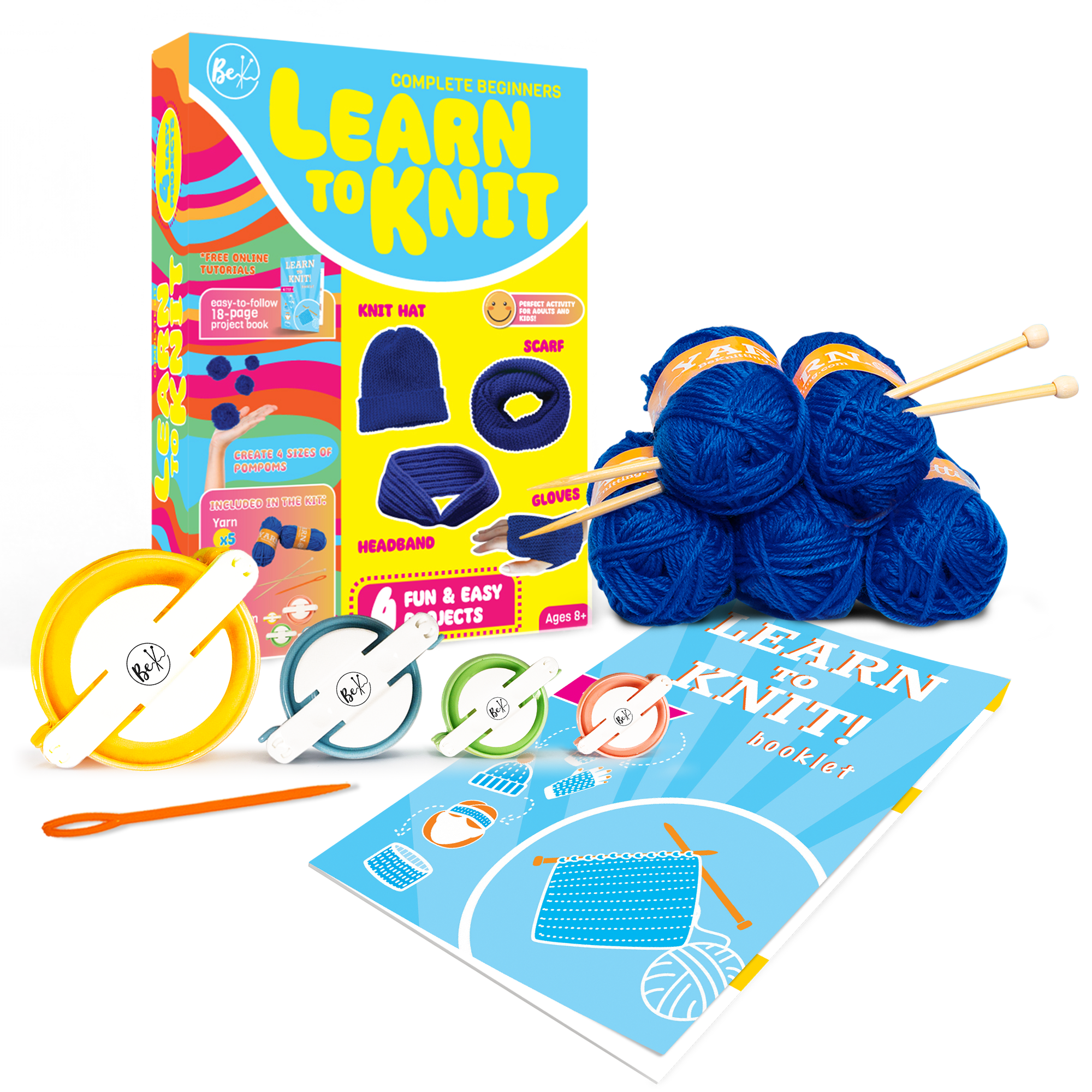
The BeKnitting kit has everything you need to knit your first cozy projects!
Get crafty with 4 FREE knitting patterns, spice up your projects with fluffy pom poms of different sizes, and practice essential knitting techniques. Learning how to knit doesn’t get easier than this!
Visit our Amazon store now!
Grab a pen, notepad, and maybe some yarn and knitting needles. Here are some easy knitting terms for beginners that you’re going to meet along the way!

CO means to cast on, which is how you get stitches onto your needle in the first place. It’s the very first step of almost any knitting project. You might see “CO 20 sts” at the start of a pattern, which means begin by placing 20 stitches on your needle.
There are a few different types of knitted cast ons. But the one I’m featuring right now is a super easy one called the Basic Knit Cast On.

The most foundational stitch in all of knitting. When you see K in a pattern, it simply means to work a knit stitch. You’ll often see it followed by a number, like K5, which means “knit 5 stitches.” If you only learn one thing from this list, let it be this one.

P stands for purl, the second most important stitch a beginner needs to know. The purl stitch is basically the knit stitch worked in reverse, and combining the two opens up a whole world of texture and stitch patterns. Just like knit, you’ll see it paired with numbers: P3 means purl 3 stitches.

This is your first decrease! K2tog means you insert your needle into two stitches at the same time and knit them as one. It reduces your stitch count by one and leans slightly to the right. You’ll see this in shaping sections, like when a hat starts tapering at the top.

Another decrease, but this one leans to the left. SSK means you slip two stitches one at a time as if to knit, then knit them together through the back loops. It’s the mirror image of K2tog, and the two are often used in the same row to create nice, symmetrical shaping.
YO means to wrap the yarn over your needle before working the next stitch. This creates a new stitch and a small decorative hole, which is exactly how lace patterns are made! It’s also used as a way to increase your stitch count.
You’ll see st and sts everywhere in patterns. It’s just shorthand for “stitch” or “stitches.” As in: “Knit to last 3 sts, k2tog, k1.” Nothing tricky here, just a space-saver.
Rep means you’re going to work the same set of instructions more than once. Patterns often say something like “rep from * to end.” That asterisk marks the start of the section you’re repeating. Once you get the hang of it, it makes patterns much easier to follow.

BO means bind off (also called “cast off” in UK patterns). This is how you secure your stitches and finish your knit piece so it doesn’t unravel. There are many different bind off techniques, but the best one to learn for beginners is the Basic Knit Bind Off.
RS means right side, the “pretty” side of your fabric that faces outward when worn. WS means “wrong side”, which is the inside of your project. Patterns will often say “with RS facing” to make sure you’re working on the correct side. This is one of those knitting terms for beginners that seems small but makes a big difference!
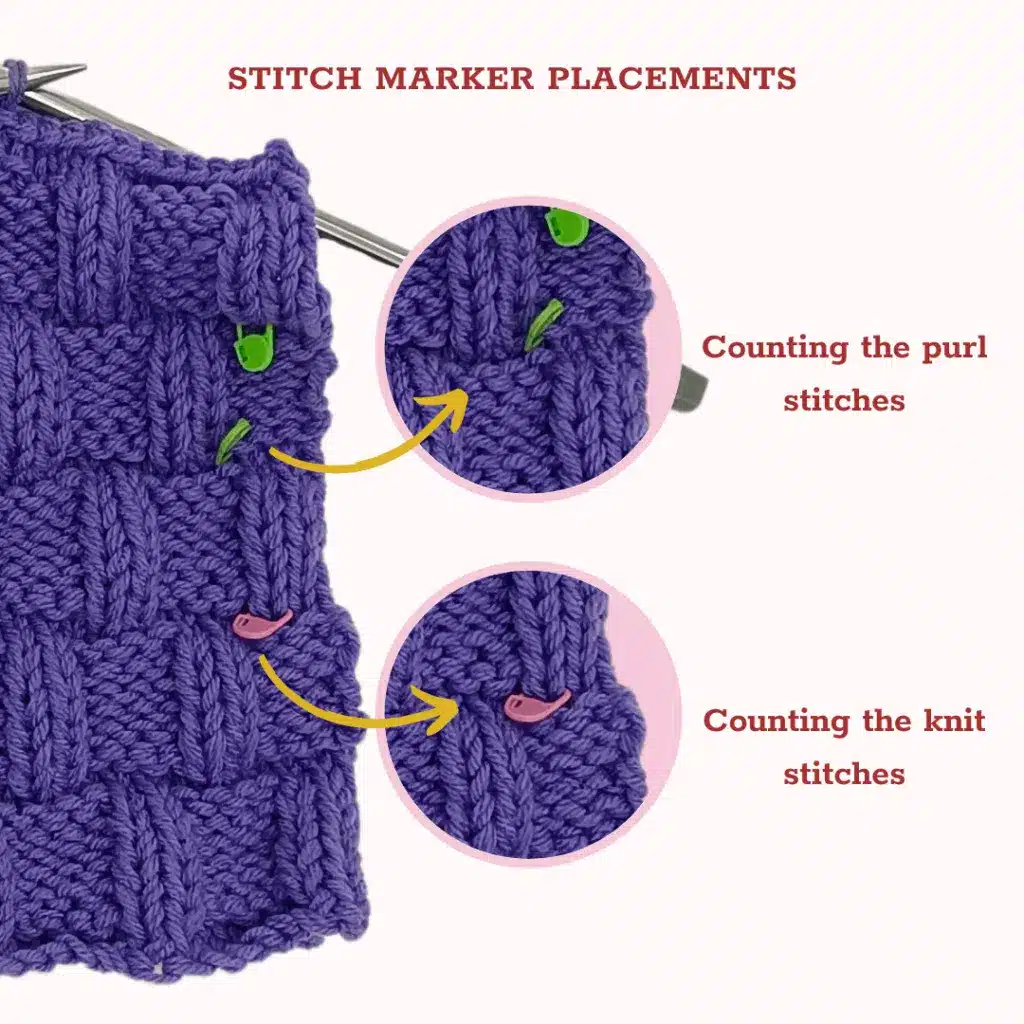
PM means to place a stitch marker onto your needle between stitches. A stitch marker is a small plastic ring or loop of yarn that helps you keep track of where sections begin and end, especially in circular knitting. When you reach a marker while knitting, you SM (slip marker) by moving it from one needle to the other.
The image above is an example of what it looks like when you’re placing stitch markers into your project. This is from our Knit Basketweave Dishcloth Pattern.

St st is one of the most classic stitch patterns in knitting. You create it by knitting one row and then purling the next row, alternating as you go. The result is that smooth fabric with a V-shaped pattern that you see on most sweaters and beanies. In circular knitting, you just knit every round to get the same effect.
Inc means to add a stitch, making your knitting wider. Dec means to remove a stitch, making it narrower. These are the building blocks of shaping and how a simple knit rectangle becomes a fitted sleeve or a tapered hat.
These instructions tell you where to hold your yarn before working the next stitch. WYF means bring the yarn toward you; WYB means bring it away from you. You’ll often see these paired with slip stitch instructions.
Cont simply means to keep doing what you’ve been doing. “Cont in pattern as established” means carry on with whatever stitch pattern you’ve been working on, no changes needed.
Learning knitting terms for beginners takes a little time, but it really does click fast. The more you knit and read patterns, the more these words become second nature. Before long you’ll be tossing around terms like “frogging” and “swatching” like you’ve been doing it for years.
Come back to this guide any time you hit an unfamiliar word. That’s exactly what it’s here for. And if you want to keep building your skills, we have plenty more beginner guides, tutorials, and free patterns waiting for you right here!


